R.F. Lafferty & Co. Inc. is a diversified full service broker dealer
The process is to open an account, and as new issues come to market
you will be notified of them. These notices will include information
about the issuer and investors can decide if they are interested or
not. If you are interested, you can submit an indication of interest to
your dedicated investment representative.
To get started with this process, click here to open an account @ R.F. Lafferty & Co. Inc.
There is no minimum and you do not need to be accredited. Note that
IPOs are available to established relationships ONLY, and are given to
the most active customers. It is not possible to open an "IPO
Account."
Full Service Brokerage accounts with R.F. Lafferty & Co. Inc. include:
- Research
- Access to markets including Stocks, Bonds, ETFs
- Fixed Income
- IPOs
- Managed Accounts
- Municipal Securities
- Options
- Day Trading
Click here to start the process of account opening
Steps to investing in IPOs with VCC:
- Open a brokerage account at RF Lafferty & Co. Inc. ( click here to open an account @ R.F. Lafferty & Co. Inc. )
- Fund your account with any amount you want to invest in IPOs, there is no minimum.
- You will receive information about upcoming IPOs by email.
- When you are interested in the IPO, either notify your registered
rep of the size you are interested in, or fill out an indication of
interest form (below). - Once the IPO is live, the funds will be deducted from your account
based on the IPO price and you will see the shares in your account.
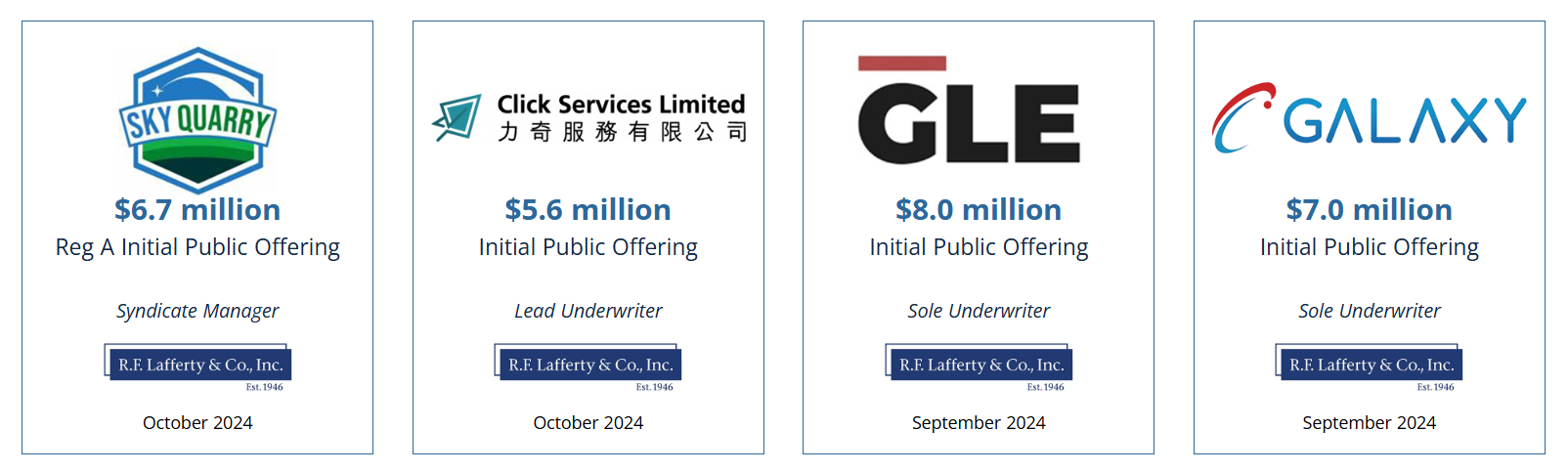
Recent transactions
 |
|---|
https://portal.vccross.com/services/ipo
For more recent transactions, see this page @ RFLafferty.com
OPen brokerage account

Understanding an IPO: A Comprehensive Exploration
An Initial Public Offering (IPO) is one of the most significant
events in the life of a privately held company. It marks the moment when
a company transitions from being privately owned to becoming publicly
traded on a stock exchange. IPOs not only provide a pathway for
businesses to raise substantial capital but also offer investors an
opportunity to own a piece of a company’s future. This article explores
the mechanics, motivations, risks, and implications of IPOs, objectively
analyzing their role in modern financial markets.
What Is an IPO?
An Initial Public Offering (IPO) occurs when a private company offers
shares of its stock to the public for the first time. The process
involves registering with financial regulators, such as the Securities
and Exchange Commission (SEC) in the United States, and listing shares
on a stock exchange like the New York Stock Exchange (NYSE) or NASDAQ.
During an IPO, a company issues new shares, which are purchased by institutional and individual investors. The funds raised are typically used to finance expansion, pay off debt, or invest in research and development. In some cases, existing shareholders, such as company founders, employees, or early investors, sell part of their stake during the IPO, converting their holdings into liquid assets.
Key Participants in an IPO Process
The IPO process involves several key players, each with a distinct
role in ensuring a successful transition to the public market:
- The Issuing Company: The company going public
initiates the process by deciding to issue shares. It often seeks to
raise capital for growth while gaining access to public markets. - Investment Banks (Underwriters): Companies usually
hire one or more investment banks to act as underwriters. These banks
assist in pricing the shares, preparing regulatory filings, marketing
the IPO to investors, and ensuring the sale of shares. - Regulators: Financial authorities such as the SEC
oversee the IPO process, ensuring that the issuing company complies with
legal and disclosure requirements. - Investors: Institutional investors (e.g., mutual
funds, hedge funds) and retail investors (individuals) participate in
the IPO, buying shares during the initial offering. - Stock Exchanges: Once the IPO is complete, shares are traded on a stock exchange, providing liquidity to shareholders.
Leave a Reply